Thursday, September 5, 2013

Forever Evil and Nightwing Un-masked!

So I've been away for a long, long time. Since I've last posted: 
The Dark Knight Rises came out -- it was awesome, though sort of out of place.
Damian Wayne died -- sad, but predictable.
Bat-cow happened -- I don't think it's as cool as everyone else.
Nightwing moved to Chicago -- since the writer is from Chicago. 
Gail Simone was fired -- and then re-hired, as the Batgirl writer.
Batman: The Dark Knight still sucks -- though I hear 'Tec has been better!

That aside, things also changed outside the Bat-universe as well. This thing called "Trinity War" happened. No one really cared. Apparently it didn't suck. But sadly, it was another Geoff Johns event comic (like Flashpoint) that seems to serve the purpose of creating a new status quo for all of the on-goings. 

I know this kills my credibility, but I can't give you the exact circumstances. Anyways, something happened and the Justice League is "missing" and the Crime Syndicate from an alternate Earth has come to conquer the world. This is a fine plot and could lead to lots of fun, but DC will probably just make it lame by trying to make it too intense and too dark. That's what DC editorial does.

But I digress -- in issue #1 Nightwing is dropping Mr. Zsasz at Arkham when he gets kidnapped by the Crime Syndicate -- who decided to reveal his identity to the world. Lots of people have pointed to the Spider-Man parallels. To me this is not the largest problem. To me, the biggest crime is against the Dick Grayson character and fan-base. DC Co-publisher Dan DiDio has long had a penchant and reputation for hating Robins -- once trying to kill Dick Grayson previously in Infinite Crisis. 
Nightwing is a masked super-hero with a secret identity. Super-heroes have secret identities to protect those around them. If a super-villain knew his identity, it would put the lives of those close to him in danger. DC literally just published a story in Batman about this. In fact, Nightwing was a part of this crossover.

You cannot re-claim a secret identity by any reasonable means. To do so would involve some sort of retcon, by either magical or supernatural means. Therefore, this means there are two options going forward:

1.) Dick Grayson is officially "out" as a super-hero. This puts the entire Wayne family and Haly's Circus in constant danger.

2.) You have to retcon this fact later on. Do I have to explain why writing a story that has to be un-done almost immediately out of necessity is stupid? 

So it's a poor storytelling choice. You either ruin your own story, or ruin the Nightwing title. Maybe Geoff Johns has a way out of this. Maybe they're just performing character assassination and this is Dan DiDio's personal vengeance against all of his own fans lashing out against his previous attempts to kill the character. Maybe DC just has no idea what they are doing. Again, this is the company that fired Gail Simone and gave Scott Lobdell three titles to write.

Times like these makes it tough to be a DC fan. I strongly prefer the DC Universe to Marvel. But as DC continues to pull stunts like this in attempts to be "cool" and "edgy" it has driven fans away. If this story fails to create a universe where it can continue to write good Nightwing stories (that have sold decently well), and thus tanks the Nightwing title, maybe this will be the slap in the back of the head DC needs. (Obviously the best strategy for a comic company is ruining what is historically their fourth-most important character besides Wonder Woman, Batman, and Superman).  

Yes, this bothers me. The sad thing is that the Nightwing title was just starting to get to get good too.....


Tuesday, June 5, 2012

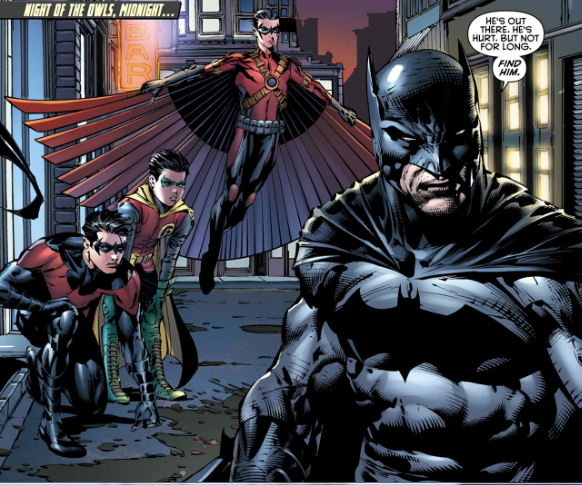
Night of the Owls


To save time, I'm going to make one long post on the Night of the Owls crossover this month. First off, Scott Snyder is nothing but brilliant with his Court of Owls story. This is a really cool tale, an all-time classic in the making. I love the Gothem he's created, my only regret is that he's working with such an established property, taking away the chance for him to truly build his own.

But that's what is great about of the Court of Owls. It allows him to establish a new part of Gotham, previously untouched significantly by other writers (Gotham certainly didn't have a blank history, but it was largely unexplored). He can build something from the ground up, allowing it to precede Bruce in Gotham. Something that's hidden ages before his birth is much harder to discover than something of his own time that he can see infiltrating his world as an adult.

The Night of the Owls was a perfect event for a crossover because it provided a legitimate reason for all the different Gotham vigilantes to get involved. One, when Batman (even if Alfred delivers the message) calls and asks for help, you answer. Second, zombie assassins are taking over the city, you better stop them. It's also perfect for the crossover because it adds a time-felt breadth to the event. It feels like a lot to read, as if a lot is happening, and this is because it is. If there are dozens of assassination attempts all over Gotham, the event should read as such!

In those cases, the event was a total success. There was some great individual pieces of work, and the pieces tied together well with no major hiccups or inconsistencies. Hell, even Judd Winick wrote some stuff that was pretty good (kidding, Winick has written many good things).

Quick overview: the good titles were Batman, Batman and Robin, Nightwing, Batgirl, Red Hood and the Outlaws, and surprisingly, Batman: The Dark Knight. The average ones were Birds of Prey and Batwing, and the poor ones were All-Star Western (tough to pick up for a one-shot) and Detective Comics (nothing new here).

If I were to give the whole event a rating, I think I'd give it a 8.7/10(B+). It accomplished its goals, there were some great moments (Tim Drake and Jason Todd had one particular amazing one in RHATO, Nightwing swordfighting, Batman doing the Iron Man thing, among others) and no huge flaws.

Friday, May 18, 2012

Sorry everyone who actually reads this blog.

I had a really rough semester, and the blog got away from me, I simply didn't have time for it. Luckily, my life is finally slowing down and I plan on starting it up again.

Stayed tuned!

Tuesday, January 24, 2012

Red Hood and the Outlaws #5

I've been a large proponent of this book since the first issue where half the comic world went crazy because she slept with Roy on a whim. It's been a great action book with fantastic art and a compelling story. I find all three characters very likable, and there have been some great moments that have surprised us all. Sadly, issue #5 doesn't quite live up to the quality of the first four issues, and leaves the reader with a somewhat anticlimactic conclusion to the fight scenes introduced in issue #4.

Issue #4 set up this great dichotomy between Jason's fight against the "Untitled" and Starfire's battle against the vengeful monster "Crux." Crux had depowered Starfire, and Jason was in a fight against a seemingly immortal creature where he dual-wielded swords. That was cool, which is an adjective underused when thinking about Jason as the "Red Hood," frankly, he's just cool.

Saturday, January 21, 2012

Batman #5

The idea of a legend has always intrigued me. When does someone become a legend? How do we distinguish a legend from something very impressive? Who decides what's a legend and what's not? I used to believe that legends are always made after-the-fact. That you can never determine what is and isn't legendary until you've told their story thousands of times. The time frame after-the-fact can shift, sometimes it's the next game, sometimes it's years down the line (for instance, the day after Kobe Bryant scored 81 points in one game, I knew it was a legend, but I didn't realize until years down the line the true legend of Michael Jordan. Sure, we all knew he was great, but it wasn't until after he was gone and we realized no one could measure up, and as each year passes and Kobe Bryant, Kevin Durant, Dwyane Wade, and LeBron James fail to measure up, MJ's legend grows.

Scott Snyder has challenged that notion for me. After reading Batman #5, I'm certain, we're living through one oft he greatest Batman stories, ever, a legendary one that'll be part of Batman canon forever. Scott Snyder is that good, while I don't enjoy this story as much as I did his previous one, "The Black Mirror," I certainly realize that this current story is a step above, and if it ends as strong as it starts, will be on every legitimate list of top five Batman stories ever.

Nightwing #5

Nightwing #5 is an interesting issue. The characterization and art are spot on, but the script is weird, and it's probably thus far the best example of Kyle Higgins' first five issues. Right now, Kyle Higgins seems interested in doing mostly one-off stories, which end with slight advancement of an ongoing plot. And that's fine, but there is something off about it, and after a lot of thought, I think I've put my finger on it.

The thing is, the main stories are rarely tying back into the larger story arc. If the adventure in issue five had much of anything to do with Saiko and the circus as a whole, that would be great. This story centers around a random circus clown with a vengeful ex that has somehow conjured a monster to come after him. The fight was cool, and Nightwing's actions int he story were spot on, but this begs the question "why the hell are you telling this story?" How does this matter, what's the point in telling this story?

Wednesday, January 18, 2012

Batgirl #5

The first four-issue story featuring the villain "Mirror" was a pretty decent start to the new Batgirl series. While maybe a little obvious, it was thematically relevant as Barbara's main issues are the ones she sees when she looks in the mirror, metaphorically that is. So far, the most difficult challenges for Babs have been insular, dealing with her recovery from paralysis, conflicted feelings about Dick Grayson/Nightwing, and now -- Mommy issues!

Although Gordon family history is somewhat convoluted (Babs is the niece/adopted daughter/possible biological daughter of Jim Gordon), what one needs to know is that the Barbara Gordon who has shown up mysteriously is Jim Gordon's ex-wife, the former adopted mother of Babs. Make sense? Good. Now I can actually talk about the story.

Sunday, January 15, 2012

Batman and Robin #5

Time to get back on the snide and getting these out on time....ish. Batman and Robin 5 previews the possible fall of Damian Wayne. While the four previous issues have shown concern for Damian's mental state (frustrations with Bruce, abuse to animals, needless violence, etc.) issue five proves to be the tipping point as he teams up with Morgan Ducard (our villain Nobody) to "fight crime" in Gotham. Ducard's trying to turn Damian (why? we're not sure yet, other than the general undermining of Bruce's Batman INC).

This issue also features a little backstory for Bruce's past with the Ducards, and the brief nut needed personal history of Morgan and his father Henri. Basically, Henri Ducard was a mercenary agent for various governments who had nowhere else to turn, who fell in love with and married a terrorist agent hired to kill him. They had a child, the terrorists threatened to kill the son if she didn't kill Henri. She agrees, the son Morgan overhears, and kills his mom, convincing his father that he was the only one who truly cared about him, at which point Henri began to train Morgan.

Sunday, December 25, 2011

Batman, Incorporated: Leviathan Strikes

Surprisingly, this blog post is my first chance to really delve into Grant Morrison. Now I have a certain fondness for Grant Morrison - Batman and Robin Vol. 1 is what really got me into comics. But sometimes he can get overly convoluted with his writing and create complicated stories for complexity's sake, not for the benefit of the actual story.

That being said, that's what Batman, Inc. was. Overly convoluted story that created confusion just sot eh reader thought harder, not that it benefited the actual comic. While it had some good moments, it was mostly forgettable. Instead of focusing on making fun adventures and being subtle about many minute details and key phrases/ideas Morrison wanted to use, he made it all about his mystery and "clues" and making a mystery no one was truly interested in. Luckily for the readers, despite these frustrations, Batman, Inc.: Leviathan Strikes is still very enjoyable.

Red Hood and the Outlaws #4

Despite early criticism, I stuck with this title because of the same promise I saw when this book was announced last summer. And boy is it paying off now. This issue and the last are some of the most entertaining pages in the last few months of the DCnU. While some are letting anger over revised histories cloud their ability to read the book, what see is a book full of action with new and unique character dynamics and the freshest title I'm reading in the New 52.

This issue picks up in a bar in Colorado, Roy Harper lamenting how Jason dragged his alcoholic self inside. Of course, Jason proceeds to kick someone's ass indiscriminately and blow their cover. Because of course Jason is, if nothing, discrete.  Of course the arresting officer turns out to be the baddie from the "Untitled."

Saturday, December 24, 2011

Batman #4

This issue, while not particularly amazing itself, shows exactly why Scott Snyder's Batman is so good. He knows how to add to the Batman mythos without changing it, and also understands the character dynamics as well as any writer ever has.

While this isn't the most exhilarating issue, it does some great introspection on Bruce Wayne, telling the story of how he investigated the Court of Owls as a child shortly after his parents were murdered. Judging by thisstory, Snyder interprets the birth of Batman from the moment that Thomas and Martha Wayne died. And from little is told about the period from that moment until his overseas training, adding this story this greatly shapes what one interprets then to happen over the rest over Bruce's formative years. Bruce has now always been Batman since that young age.

Justice League #4

For as awesome as Justice League is supposed to be, so far the first four issues have been decidedly....not awesome. And this all rests on the shoulders of Geoff Johns, as Jim Lee's held up his end of job epically. The problem with this series stems from its concept -- the origin of the Justice League set in the past. What is intriguing about this concept? Why does this story need to be retold other than to establish differences between the old DCU and the DCnU?

Compiled on top of that, Geoff Johns has very slow moving plots, and considering he is working with seven characters he wants  to give fairly equal screentime to, well that makes things slower. Maybe Geoff Johns is building towards something awesome, like this book desperately needs, but all I find myself thinking when I read this is "ok, enough with the alien invasion, when is something going to happen?" And then I pick up the next month's issue, and nothing ever does.

Nightwing #4

In terms of quality, the first three issues of Nightwing are on par with nearly any title in the "New 52." Much of its quality was based on the often stunning (although sometimes inconsistent) art of Eddy Barrows. But for whatever reason, Eddy Barrows is having trouble meeting deadlines, with issue #3 being finished by Eduardo Pansica, and issue #4 being entirely drawn by Batman: Gates of Gotham artist Trevor McCarthy.

While by no means is Trevor McCarthy a bad artist, he's a terrible fit for this series. While some have championed that he has a fluid, motion-like style, his pencils look to cartoonish and Scott McDanielesque (that's never a good sign if you're a Nightwing fan) for the tone this series has had thusfar. In particular, the faces I find very flawed and off-putting.

Wednesday, November 23, 2011

Red Hood and The Outlaws #3

The first two issues of "Red Hood" were good, not great, essentially good enough to keep reading. Issue number thee however, was awesome. In an upset, this comic was better than both Batman and Nightwing, exploring the inner-selves of Roy, Jason, and Kori, while also telling a great adventure for the trio to retrieve ...a snowglobe?

In order for them to retrieve this artifact (calling it a snowglobe makes the story sound silly, it's not, it's a cool quest). They have to each give up their most cherished memory as collateral to "Saru the Proctor" in exchange for their journey to find the artifact. Saru takes a peak at Roy's and Kori's cherished memories, knocking Kori for her overly-violent memory being her most-cherished, and Roy for having too much sympathy.

Monday, November 21, 2011

Batman #3


If one could make a true criticism for Grant Morrison's Batman story, it would be that it has become too large. Batman, after-all is mostly Gotham-centric, and to have him globe-trotting and travelling through time is somewhat grand for the mythos of Bruce Wayne. After-all this is Batman, not Booster Gold. It almost felt like Bruce Wayne became some sort of "Bat-God" and was invincible as Superman.

Scott Snyder does not have this problem, he is much more focused on the dichotomy of Gotham and Batman. Bruce is grounded back to his human abilities and superior technology, a mere mortal once again. And ff you haven't figured out that Gotham is its own character in his stories, you're behind the eight-ball, and need to catch up fast. While the Court of Owls appears to be his villain in this story, they're just a larger function of Gotham's malice.

Nightwing #3

Nightwing #2 was awesome. It had action, romance, and drama -- it kept the reader on the edge of the seat and looked awesome. I was hoping that would lead to a great next issue, but unfortunately, it takes a small step back. While apparently the creative directive for DC has been not to focus on the past events of the characters, this issue deals almost exclusively in filling in the gaps from Dick's past.

A couple things to note. I don't remember the exact age Kyle Higgins said Dick became Robin, but it's not nearly as young. If I remember correct, the old age was 12, but now it's probably more like 15 or 16, as Dick is definitely at least 12 in this flashback to his past at the circus. And I like the contrast between what Haly Circus is now and what it was then. When Dick goes back to the circus to visit it's usually all smiles and happy days, but this shows a Haly Circus that resents him for leaving and isn't always all honky-dory. 

Thursday, November 10, 2011

Batgirl #3

One of the important Post-Flashpoint questions is how do all these characters now relate to each other. We've seen a dynamic shift in Bruce and Damian's relationship, as well many couples are split up, including Lois and Clark. Bringing in Nightwing for issue #3 establishes Dick and Bab's relationship, last touched on in Scott Snyder's "Detective Comics" run.

From Barbara's point of view, there's obviously a lot of sexual tension. She can't help but think back to their days as Batgirl and Robin, recalling how her "ballet" and his "acrobatics" were in perfect sync, a way of flirting. They chase each other throughout Gotham, Babs of course becomes pissed because he's checking up on her as Bruce and Dick are obviously trying to play big brother and protect her from herself. Dick gets her to rationalize that it's not because they don't trust her, it's because they care about her.

Batman and Robin #3

 This continues to be one of the top five ongoings as a result of the "New 52." Tomasi seems born to write Batman (his past as a Batman editor obviously helps him here), and while Patrick Gleason's pencils vary in quality (A+ on one page, lackluster on the next), together they create very fine books. It's really a shame they only got one story of Dick and & Damian, surrendering arcs to Winick (although that story was decent, good writing with up and down art) and Paul Cornell (god was that terrible).

Last issue introduced to the reader two new characters, Morgan -- who works for Henri Ducard, and Damian's new dog, who better be named Ace or I'm just going to get so annoyed. These characters both play a big role in this comic, as Damian struggles to understand the value of a dog (I guess not every 11 year old really wants a dog, maybe Damian would prefer cats? His dad certainly has an affinity for them).

Monday, November 7, 2011

Batwing #3

We're three issues in, and one can't really ask anymore of Winick than what's he's already done. Batwing is fantastic, a super enjoyable read that is a breath of fresh air. It's full of misdirection and intrigue, while also adding heart-pounding action to the mix, creating a solid balance.

This issue opens with a flashback to the past of David Zavimbe, where we see him with his brother Isaac, two soldiers as young men, terrible killing machines, but ones who refused to stoop to a level of everyone else in the force, choosing to protect women and children instead of raping and slaying them. This shows a moral high-ground in them, despite that they are working as devastating killers for General Keita's Army of Dawn.

Sunday, November 6, 2011

Detective Comics #3

I've been critical of this series, and for good reason. For the series that DC Comics is named after, the quality of the comic, especially after the relaunch, should be top notch. But they assigned Tony Daniel to create this book, and well, not much more needs to be said. The two books he's been assigned? The Savage Hawkman book, which is better kindling than it is an actual book, and the second is this book.

Simply put, Tony Daniel has been handed books and squandered both opportunities. He is a fantastic penciller, yes, but after Hawkman is cancelled and Detective Comics reassigned, I dearly hope he isn't allowed to write again. The third installment of the Dollmaker storyline isn't much better than the second, suffering from lack of "so what?" What are the stakes here, besides the whole save Gotham without trying to die in the process thing.